
How many storage units fit in a climate controlled steel building?
Quick Answer
A typical single-story steel building holds roughly 8 to 10 units per 1,000 net rentable square feet using a blended unit mix. Actual counts depend on building width, unit sizes, hallway corridor layout, wall thickness, and dead space. A 50×200 drive-up building, for example, can support approximately 100 to 105 units.
Detailed Answer
The Real Answer Depends on More than Square Footage
If you want to know “how many storage units fit in a steel building,” common answers give you a simple formula: divide gross square footage by unit size. That math looks clean on paper, but it falls apart the moment you account for corridors, wall thickness, mechanical rooms, and the unit mix your market actually demands.
A 30×100 building is 3,000 gross square feet. But you’re not renting 3,000 square feet. You’re renting the net space left over after corridors, walls, dead zones, and common areas are accounted for. The difference between gross and net can mean 10–20 fewer rentable units than a back-of-napkin estimate suggests.
This guide walks through the real variables that determine storage unit count, gives you a quick calculator to test your own scenarios, and includes reference tables for common steel building sizes with realistic unit mixes.
Quick Storage Unit Calculator
Storage Planning Calculator
Plan Your Storage Building Layout
Estimate building square footage, rentable area, unit count, and climate-control planning notes before requesting a TruSteel quote.
Use the calculator above to estimate how many storage units your building can support. Plug in your target footprint and unit mix, and it will account for corridor space, wall thickness, and common-area deductions automatically.
Keep in mind that every project is different. The calculator provides planning-level estimates — not engineered layouts. For a site-specific unit count tied to your actual location and building code requirements, request a free quote from TruSteel and we’ll provide a preliminary sketch with your building package pricing.
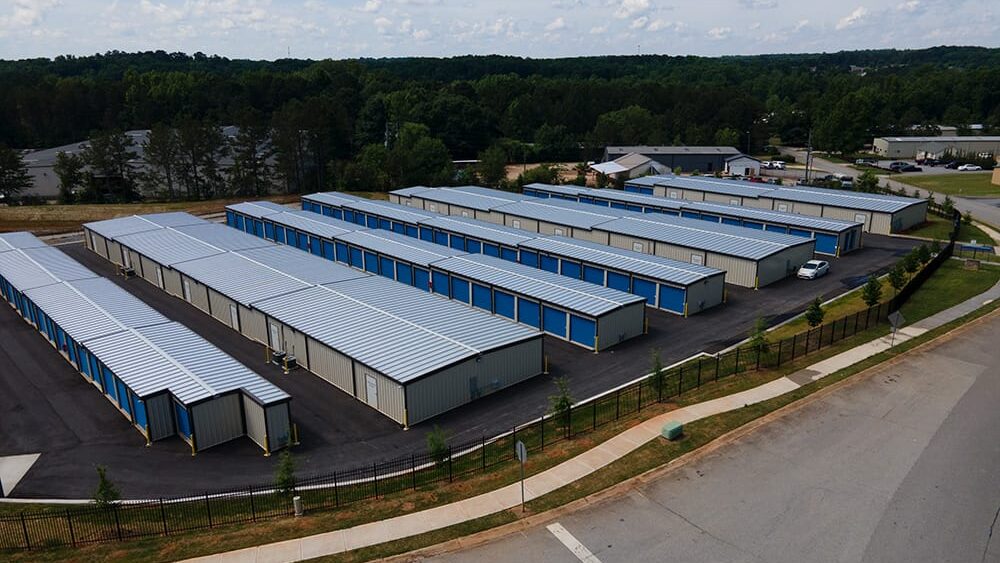
Key Variables that Affect Your Unit Count
Dividing total square footage by a single unit size ignores the variables that actually determine how many units fit inside a mini storage steel building. Here’s what drives the real number.
Building width and depth
Width determines how many rows of units you can fit side by side, while depth determines how many units run along each row. A 40-foot-wide building accommodates a different internal layout than a 60-foot-wide building — even if the total square footage is identical.
Wider buildings allow double-loaded interior corridors or back-to-back drive-up rows. Narrower buildings (30–40 feet) typically support single-loaded layouts only, which reduces unit density but simplifies access.
Storage unit mix
Not every renter needs a 10×10. A healthy storage unit mix typically includes a range of common storage unit sizes to match local demand: 5×5, 5×10, 10×10, 10×15, and 10×20. The ratio of small-to-large units directly changes how many total units your building will hold.
A building loaded with 5×5 and 5×10 units produces a higher unit count than the same footprint filled with 10×20s, but smaller units also mean more doors, more partitions, and potentially lower revenue per square foot. Your unit mix strategy should balance count against the rental rates and occupancy patterns in your target market.
Corridor and drive aisle width
Interior-corridor buildings need a minimum of 5 feet of hallway width between facing rows of units. That corridor eats into your rentable area on every floor.
Drive-up layouts require 24–26-foot drive aisles between building rows to allow vehicles to back up and load. The aisle itself sits outside the building footprint, but it directly impacts how many buildings you can place on your lot and how your mini storage floor plan comes together.
Wall thickness and structural steel
Every partition wall, exterior wall, and column takes up space that cannot be rented. Steel buildings use less wall thickness than block or tilt-up construction, but you still lose 4–6 inches per wall depending on insulation and liner panel choices. Across dozens of units, those inches add up.
Dead space: offices, mechanical rooms, and restrooms
Facilities that include an on-site office, restrooms, mechanical or electrical rooms, elevator shafts, or security infrastructure lose additional rentable area. These common areas are necessary for operations but reduce the number of leasable units in the building. Plan for them early because retrofitting dead space into a finished layout is expensive and disruptive.
Net Rentable Square Footage vs. Gross Square Footage
This is the concept that separates serious self-storage developers from first-time estimators. Gross square footage is your building’s total footprint — width times length. Net rentable square footage (NRSF) is the portion of that footprint a tenant can actually lease.
The industry standard efficiency ratios are:
- Single-story drive-up buildings: 75–85% efficiency. These layouts are the most space-efficient because there are no interior corridors, elevators, or stairwells. The main losses come from wall thickness and any built-in office or utility space.
- Interior-corridor buildings (climate-controlled): 72–75% efficiency. The enclosed hallways required for tenant access reduce rentable area more significantly. Multi-story interior buildings lose additional space to stairwells, elevators, and fire-rated corridors.
What this means in practice: a 10,000-square-foot drive-up building might yield 7,500–8,500 rentable square feet. The same 10,000-square-foot footprint as a climate-controlled interior-corridor building might yield only 7,200–7,500 rentable square feet.
Understanding NRSF is critical when you’re projecting revenue, because you lease net square feet, not gross. Build your mini storage business plan around NRSF from day one.
Single-Loaded vs. Double-Loaded Corridor Layouts
How you arrange unit rows inside the building changes your count significantly.
Single-loaded corridors
Units line one side of the hallway only. This layout is simpler, provides better ventilation and natural light options, and works well in narrower buildings (30–40 feet wide). The trade-off is lower unit density — you’re dedicating corridor space that only serves one row of units.
Double-loaded corridors
Units face each other across a shared hallway. This is the more space-efficient layout and the standard for most interior-corridor climate-controlled buildings. A double-loaded corridor in a 50-foot-wide or wider building can nearly double your unit count compared to single-loaded, because one corridor serves two rows of units instead of one.
The choice between single and double-loaded layouts depends on building width, target unit sizes, and whether you’re building drive-up or climate-controlled facilities. Your building’s structural clear span also matters — and that’s where a pre-engineered steel building gives you an advantage, because red iron framing delivers column-free interiors that maximize usable layout space.
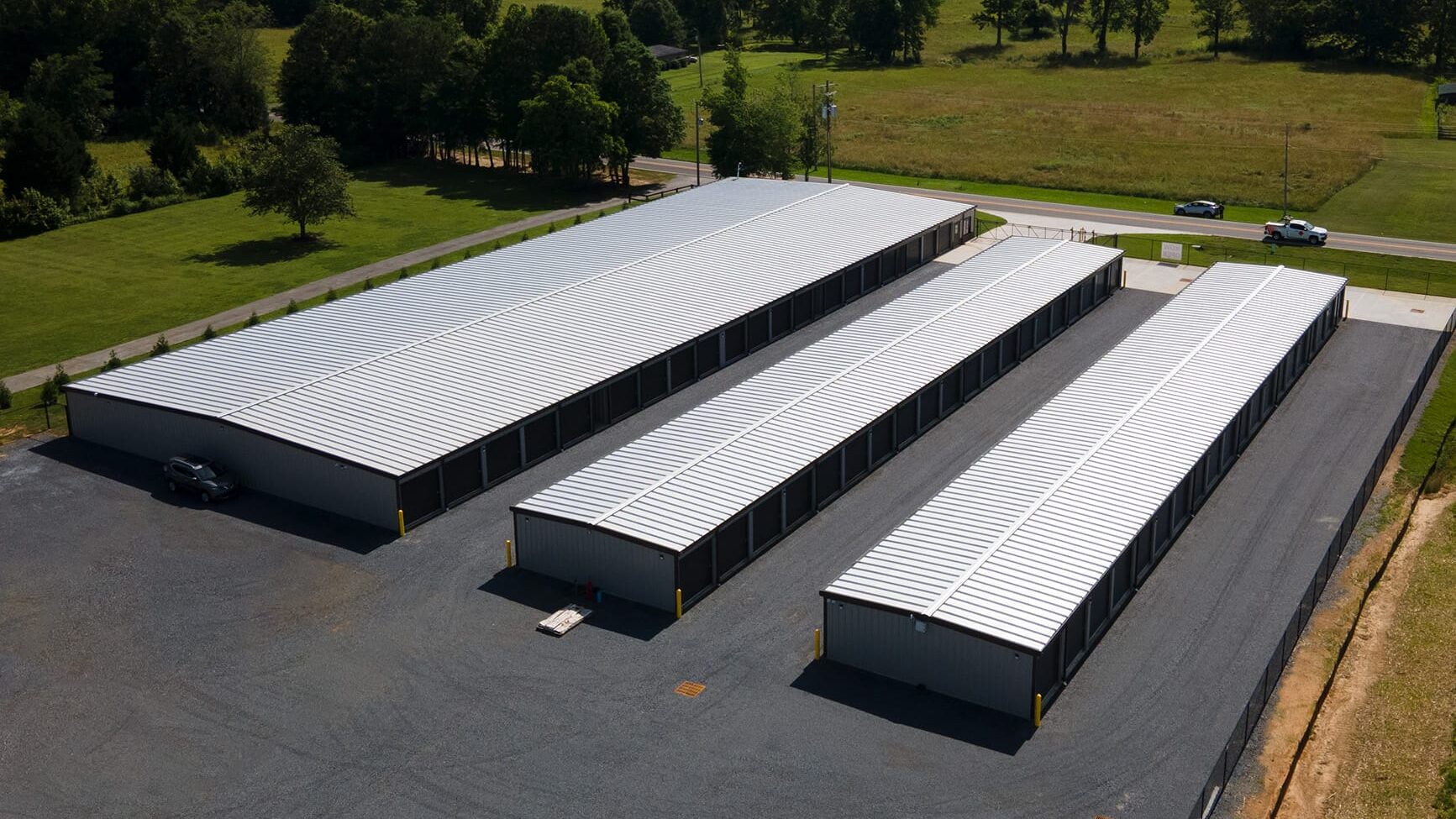
Estimated Unit Counts for Common Steel Building Sizes
Here’s what realistic unit counts look like across a range of popular mini storage building footprints. Each estimate uses a blended unit mix of 10% 5×5, 25% 5×10, 35% 10×10, 20% 10×15, and 10% 10×20 — a typical spread for a suburban self-storage market.
All estimates below assume a blended unit mix (10% 5×5, 25% 5×10, 35% 10×10, 20% 10×15, 10% 10×20) with a weighted average unit size of approximately 78 square feet and 80% efficiency for single-story drive-up layout.
- A 30×100 building (3,000 gross square feet) yields roughly 2,400 NRSF and supports approximately 30–32 units. Step up to a 40×100 (4,000 gross square feet) and you’re looking at around 40–42 units from 3,200 NRSF.
- A 40×150 building pushes to 6,000 gross square feet, delivering about 4,800 NRSF and 60–63 units. The 50×100 falls in a similar range — 5,000 gross, 4,000 NRSF, and roughly 50–52 units.
- At the mid-range, a 50×200 (10,000 gross square feet) provides approximately 8,000 NRSF and 100–105 units, while a 60×100 at 6,000 gross square feet holds around 60–63 units from 4,800 NRSF. An 80×100 building — one of TruSteel’s most popular storage footprints — yields roughly 6,400 NRSF and 80–84 units.
- For larger facilities, a 100×200 building (20,000 gross square feet) can support approximately 200–210 units from 16,000 NRSF.
Keep in mind that these are planning-level estimates. Actual unit counts vary based on your specific unit mix, corridor configuration, wall construction, and local code requirements. Interior-corridor climate-controlled buildings should use 72–75% efficiency instead of 80%.
These numbers shift meaningfully when you change the unit mix. A building filled entirely with 10×10 units will have fewer total units than the same building with a heavier weighting toward 5×5 and 5×10 sizes. That’s why the mix matters as much as the footprint.
For site-specific estimates engineered to your exact location and building codes, reach out to TruSteel for a free quote.
How Lot Coverage Connects Building Count to Total Units Per Acre
Knowing how many units fit in one building is only half the picture. The other half is how many buildings fit on your land.
Coverage ratio (sometimes called lot coverage) refers to the percentage of your total acreage that can be covered by buildings after accounting for setbacks, parking, drive aisles, stormwater retention, and landscaping buffers. For most self-storage sites, the buildable coverage ratio falls between 30–50% of total acreage.
On a 3-acre parcel (roughly 130,000 square feet), a 40% coverage ratio gives you approximately 52,000 square feet of building footprint. That might translate to five or six individual 40×150 or 50×200 buildings, each holding 50–100+ units depending on your layout and mix.
The math scales, but the site constraints are unique to every parcel. Setback requirements, access road widths, parking minimums, and retention pond sizing all vary by jurisdiction. Your site plan should map all of these factors before you finalize your building order.
How Multi-Story Changes the Math
Adding a second or third floor multiplies your rentable area on the same footprint, but not by the full factor you might expect.
A two-story building on a 10,000-square-foot footprint gives you 20,000 gross square feet. But multi-story layouts require enclosed stairwells, elevators (for ADA compliance and tenant convenience), fire-rated corridors, and mechanical shafts that single-story buildings don’t need. Plan to lose roughly 25% of each upper floor to these common areas.
That means a two-story building doesn’t double your unit count, it typically delivers 1.7x–1.8x the units of the single-story version. A three-story building might yield 2.4x–2.6x, not a full 3x.
Multi-story is most common in climate-controlled, interior-corridor facilities where land cost is high enough to justify the added construction complexity. If your site has room for single-story drive-up rows, that’s usually the more cost-effective path to maximizing unit count.
Start with the Right Building — Unit Count Follows
The number of storage units your steel building can hold depends on your footprint, your unit mix, your corridor layout, and your local building codes. A quick formula can get you in the ballpark, but the real answer comes from a site-specific layout tied to your actual parcel and market.
TruSteel provides mini storage steel building kits with county-specific stamped plans, 100% steel construction, and a 30-year manufacturer’s warranty on panels and columns. Our team works with self-storage developers and investors nationwide — from first-time operators to experienced facility owners adding new phases.
If you have a zip code, a target footprint, and an idea of your unit mix, you’re ready to get started.